n 15 October, Mozambicans elected a new president, members of the National Assembly, provincial governors, and members of provincial assemblies.
Incumbent President Filipe Nyusi, of the Frelimo party, was reelected with 73 percent of the vote, against 21.88 percent for Ossufo Momade from the main opposition party Renamo. Frelimo also elected 184 out of 250 seats of the unicameral legislative and all 10 provincial governors.
All the provinces gave an overall victory to Frelimo, including Zambezia and Nampula where it had lost in other elections.
Mozambique’s Constitutional Council hasn’t yet made the results official.
On 21 October, Renamo declared that it “neither accepts nor recognizes” the election results, according to Deutsche Welle. A statement by its political committee said:
Deutsche Welle reported that Renamo’s president also called on “all Mozambicans to not accept the big electoral fraud [and] demand the immediate and unconditional release of all Renamo members, arbitrarily detained during the electoral process.”
MDM, another opposition party, similarly issued a statement rejecting the results:
Frelimo and Filipe Nyusi publicly thanked the voters for their participation:
Frelimo has ruled Mozambique since the end of the civil war and the establishment of multiparty democracy in 1992. Since then, Renamo has never accepted election results. In 2014 and 2015, tensions led to a new armed conflict. Three new peace or ceasefire agreements have been signed since 1992.
In 2018, Renamo’s historic leader passed away, and Ossufo Momade’s current leadership is not accepted by a faction.
The 2019 elections took place amid armed conflict between Islamic insurgents and the military in the northern province of Cabo Delgado, which has left 200 dead since 2017. The climate of insecurity prevented around 5,000 people from casting their votes.
The Electoral Transparency Platform, an election monitoring initiative conducted by five civil society organizations, pointed to irregularities in some procedures. According to the newspaper O País:
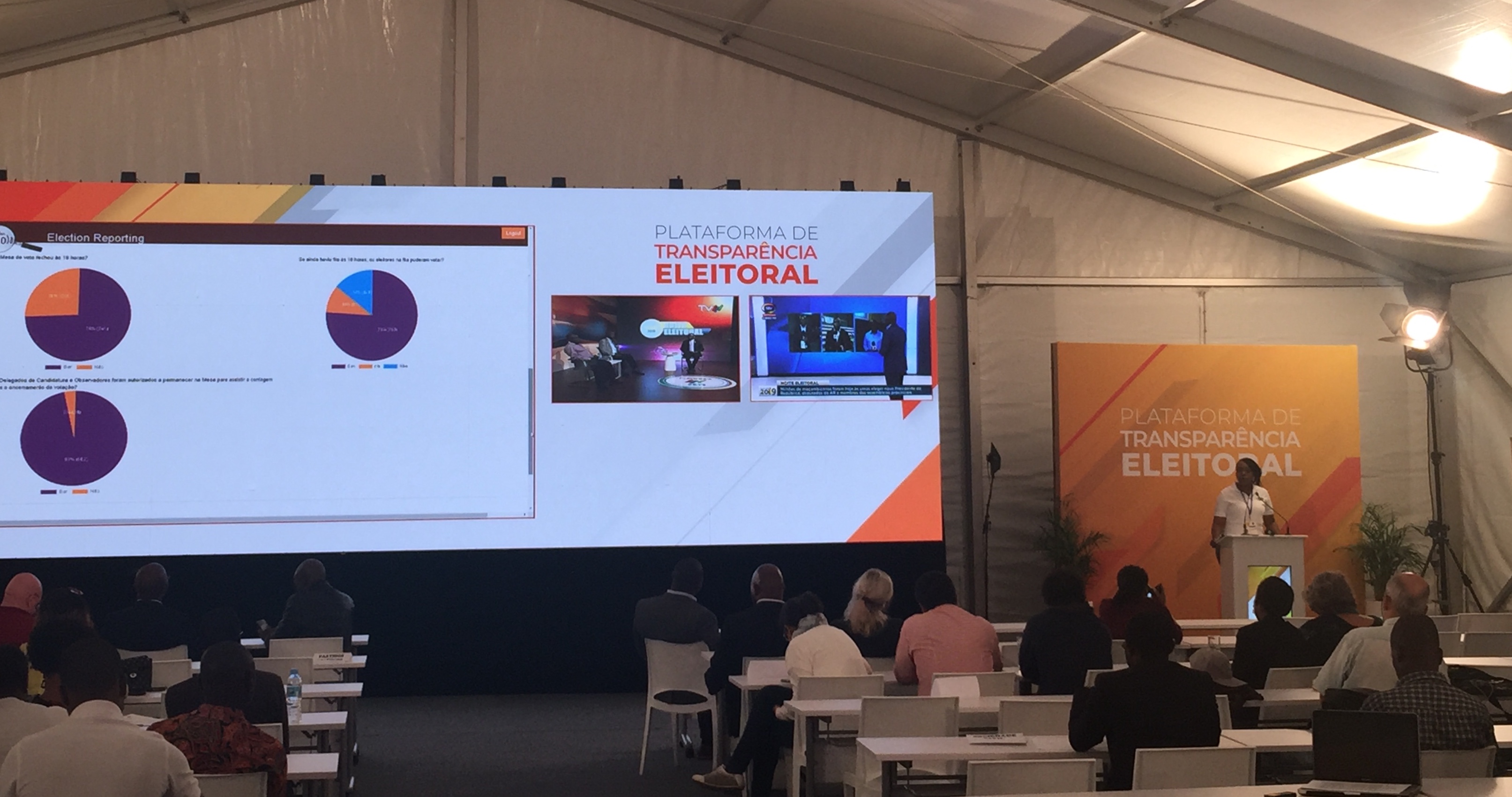
The Electoral Transparency Platform, at the Eduardo Mondlane University in Maputo. Photo by Dércio Tsandzana, 15 October 2019
Also observing were the African Union (AU), the Community of Southern African Countries (SADC), the Community of Portuguese Speaking Countries (CPLP), and the Institute for Sustainable Democracy in Africa (EISA).
The observation missions all reported that the elections were peaceful, except for violent incidents in Cabo Delgado which prevented people from voting.
Incidents during the election campaign, including killings of activists and election observers, were considered isolated and did not undermine the process’ integrity. According to news agency Lusa:

International observation missions prepare before a press conference. Photo by Dércio Tsandzana, 17 October 2019
The European Union (EU) highlighted that the process was severely compromised by mistrust between the main actors, as well as inequalities in opportunity for electoral competition and dubious voter registration:

The European Union’s observation mission gives a press conference. Photo by Dércio Tsandzana, 17 October 2019
In a statement from November 8, the EU observation mission (MOE UE) again cited irregularities and this time called for a response by the Constitutional Council:
During the campaign, there were cases where journalists were prevented from attending meetings.
Regarding journalistic coverage, there was a case of threats against a journalist who made a radio broadcast on 15 October, which was highlighted by Zito Ossemane on Twitter:
Zito do Rosário Ossumane@ZitodorosarioO meu colega, Tome Balança foi siviciado na madrugada última por indivíduos até ao momento desconhecidos pela sua verticalidade e profissionalismo na noite das eleições. A residência do balança foi cercada por essa gente que o torturaram e proferiram diversas ameaças .
1
Twitter Ads info and privacy


My colleague, Tome Balança, was attacked last night by individuals so far unknown, for his honesty and professionalism on election night. Balança’s residence was surrounded by these people who tortured him and made numerous threats.
Image: From Quelimane, the news arrives of another journalist tortured and threatened. Zito Ossumane, director of Radio Chuaba FM, a private station which operates in that city of Zambezia province, just told the DW Africa correspondent, Sitoi Lutxeque, that unknown people invaded the residence of the journalist Tome Balança…